
No products in the cart.
Perfectstroke Aim Index Pro

USD$54.86 – USD$151.68Price range: USD$54.86 through USD$151.68
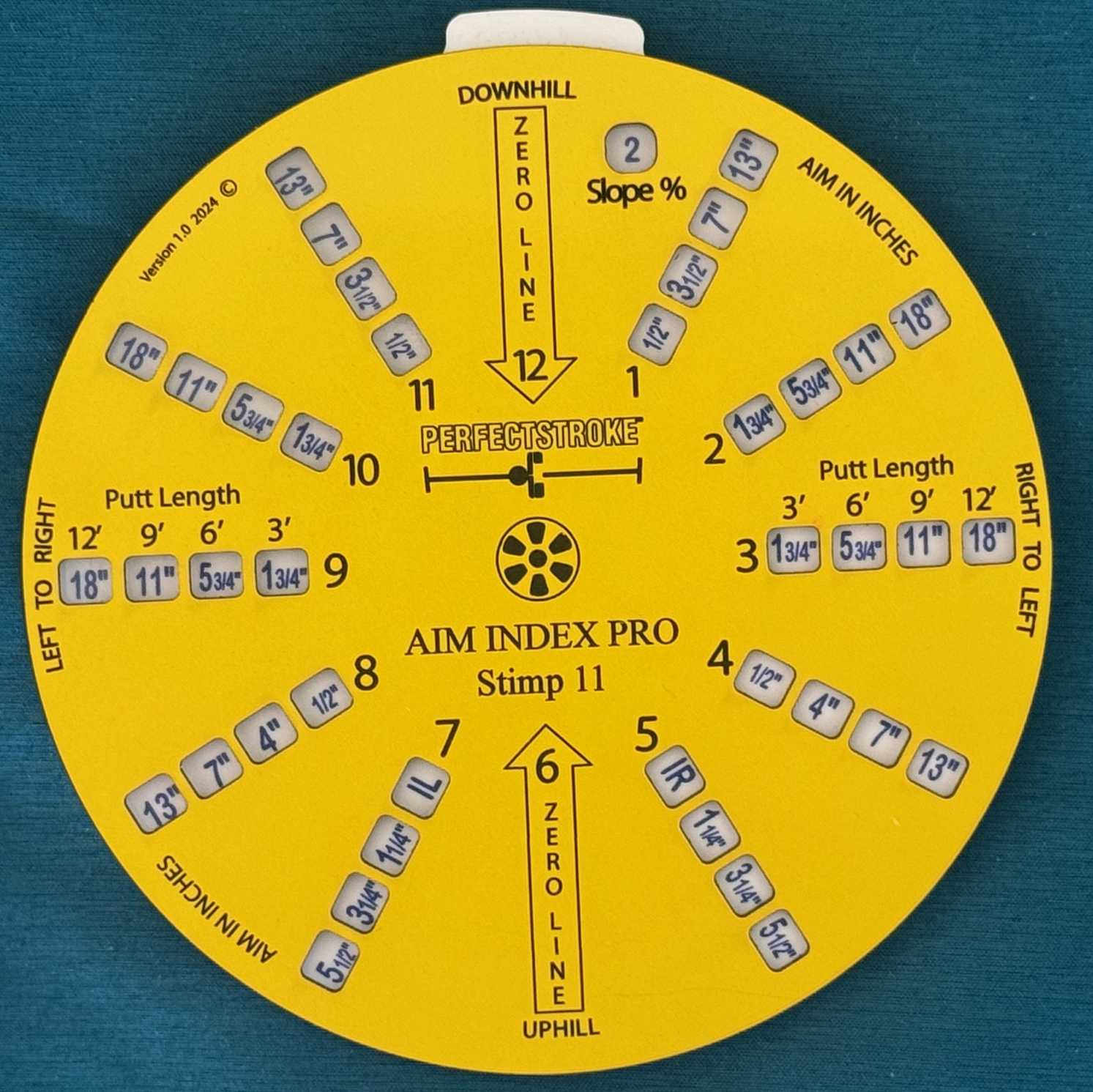
The Perfectstroke Aim Index Pro is an advanced golf putting training system designed to help players develop a more accurate, repeatable, and informed approach to reading and executing putts. Built around a structured aim-reference methodology, it transforms putting practice into a measurable and consistent learning process, enabling golfers to better understand green reading, slope influence, and break prediction.
At its core, the system provides precise aim guidance based on three key variables: putt distance, green speed, and slope percentage. The Aim Index Pro is available in both metric and imperial formats, allowing players to work in either metres or feet, with corresponding aim outputs in millimetres or inches. It is designed for use across a range of green speeds from 9 to 14 Stimp, making it suitable for practice on most standard putting surfaces.
A key feature of the Aim Index Pro is its expanded slope coverage. the Aim Index Pro delivers detailed guidance across six slope levels: 0.5%, 1%, 1.5%, 2%, 2.5%, and 3%. This allows for refined calibrations and a closer match to real-world putting conditions, where subtle variations in slope can significantly affect break and starting line.
The system is built around a clock-face reference model that simplifies green reading. In this model, 12 o’clock represents a direct downhill putt, while 6 o’clock represents uphill. Lateral positions indicate break direction and severity, with intermediate clock positions helping players interpret combinations of slope and curvature. This framework reduces the complexity of traditional green reading by standardising directional interpretation into a consistent visual language.
The Aim Index Pro provides structured aim recommendations for four key putting distances, allowing players to practise repetition from fixed points while adjusting only for slope and green speed conditions. This repetition builds familiarity with how different combinations of distance, slope, and direction influence the outcome.
SKU: test-2-2 Category: Putting Aid
The Perfectstroke Aim Index Pro is a golf putting training system designed to bring structure, consistency, and purpose to putting practice.
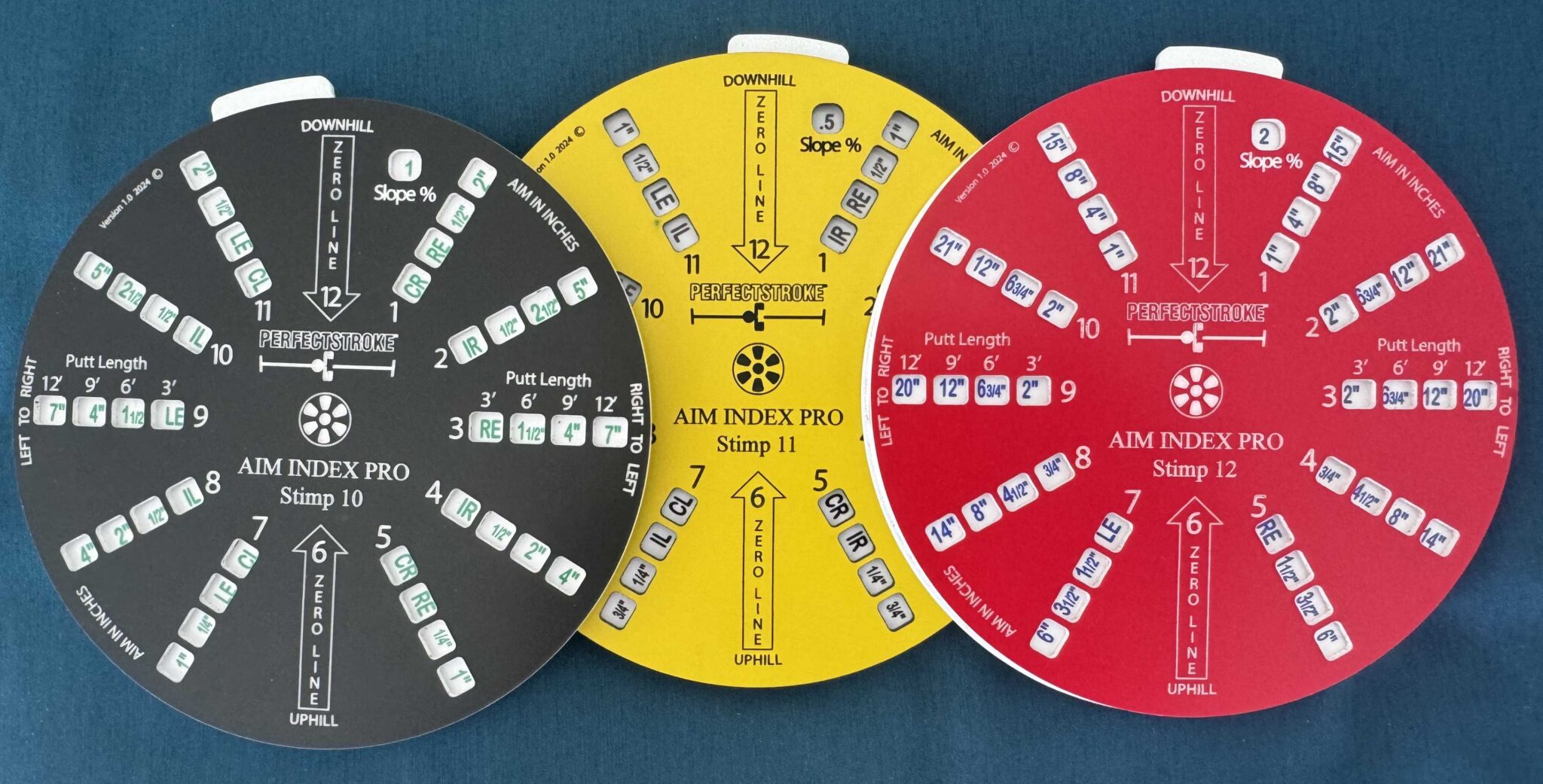
The Perfectstroke Aim Index Pro is available in imperial and metric versions. They provide precise aim predictions for putts of varying lengths across different slope percentages and green speeds ranging from 9 to 14 Stimp.
Players can practice putts from set distances across a range of slopes and green speeds, developing a deeper understanding of how much putts break and where they should aim. This knowledge can then be transferred to the golf course, helping improve performance, increase holed putts, reduce three-putts, and lower scores.
The Aim Index Pro is a single-Stimp model that provides aim references for four putting distances across six slope percentages: 0.5%, 1%, 1.5%, 2%, 2.5%, and 3%. It is available across Stimp speeds from 9 to 14 and can be purchased individually or as part of a set.
The Perfectstroke Aim Index system is designed for tour professionals and elite amateur players where scoring performance is critical, while also offering significant benefits to recreational golfers seeking to improve their putting.
The system uses a clock-face reference method, with the zero break line running from 12 o’clock to 6 o’clock. A putt struck from 12 o’clock is downhill, while a putt from 6 o’clock is uphill. Positions to the right of 6 o’clock produce right-to-left break, with 5 o’clock representing an uphill right-to-left putt. A putt from 2 o’clock will break right-to-left with some downhill influence, while putts from around 10 o’clock typically produce the greatest break.
The Perfectstroke Aim Index Pro is available in both imperial and metric formats, meaning putt distances are displayed in feet or metres, and aim references are shown in inches or millimetres.
The system can also be used as a “phantom cup” on the practice green or on-course. Players may place the Aim Index over an existing hole, aligned with the zero break line, to establish accurate putting positions based on clock-face references.
Using the Perfectstroke Aim Index
After selecting the appropriate Aim Index for the green speed being played, the player chooses a target hole or uses the Aim Index itself as a phantom cup.
A key principle of the system is that only the fall line (zero break line) needs to be estimated or measured. Side slope does not need to be separately calculated, as it is already accounted for within the clock-face system.
If the area around the hole appears uniform, the player estimates or measures the slope percentage. This is then used in conjunction with the Aim Index to determine the correct aim based on green speed, slope, distance from the hole, and the ball’s position relative to the clock-face system.
The player first identifies the zero break line for the putt, where a ball struck directly uphill or downhill would roll straight. If the slope appears consistent, they estimate its percentage and refer to the Aim Index to determine the correct aim point.
For example, on a 10 Stimp green from 9 feet, a player may read a slightly uphill, right-to-left putt and identify it as a 5 o’clock position on a 1% slope. The Aim Index would indicate an aim approximately 1/4 inch outside the right edge of the hole. If the same 9-foot putt were slightly downhill with mild right-to-left break (around 1 o’clock), the aim would be approximately 1/2 inch from the right edge.
If the fall line appears moderate, the player can refer to the 2% settings. If it appears steep, the 3% settings are used instead.
All aim measurements in both metric and imperial versions are referenced from either the left or right edge of the hole. For shorter putts, additional abbreviations are used: LE and RE (Left Edge and Right Edge), IL and IR (Inside Left and Inside Right), and CL and CR (Center Left and Center Right). The system is designed around a holing speed of 200–400 mm (8–15 inches) past the hole.
The Perfectstroke Aim Index Pro is available for Stimp speeds of 9, 10, 11, 12, 13, and 14 in both metric and imperial formats.
| Version | Metric, Imperial |
|---|---|
| Stimp | Stimp 9/10, Stimp 11/12, Stimp 13/14, Bundle of 3 Doubles, Stimp 9, Stimp 10, Stimp 11, Stimp 12, Stimp 13, Stimp 14, Set 9,10,11, Set 12,13,14 |

Reviews
There are no reviews yet.